Writing + Editorial
Recurring
Columns


Editorial Articles Optimized
for Digital Content




One story offers multiple touch points. Editorial content adapted across print, social media, websites, email, and digital channels to extend its reach and impact among audiences.
Visit the Visual Content Section for samples of content optimized for social media channels.
Professional Profile
THE WORK BEHIND THE WEBSITE
Written by Heather Ré
May, 2026
While many businesses compete for attention, some leaders first build expertise, systems, and reputation.
In a world where emerging business leaders are encouraged to focus on personal branding and digital visibility, RNH CPA, PLLC is focused on the less visible work of building a business.
Robert Hasenbalg, the principal behind RNH CPA, PLLC knew that he wanted to own his own CPA Firm.
While working full time he began rising early in the morning hours, networking with other business owners, and spending time after work doing much of the same, building relationships and establishing connections he knew would be important once he established his firm. He registered his business name with the state of New York and secured a website domain, though he stopped short of building a full digital presence.
A little over a year ago, Rob received a notice that his services, along with several other colleagues, were no longer needed due to downsizing at a local law firm where he was employed. Rob did what most people would do. He made sure his monthly expenses were covered, figured out for how long and applied for unemployment benefits to ensure he had a plan in place.
Then he did something different.
While his former co-workers were applying for jobs, which he also did at first, Rob decided that it was time to go all in on his business.
The layoff proved to be a catalyst.
Recognizing a growing need in his profession, Rob began to have conversations around acquisitions - taking over existing firms, and their clients.
With many seasoned CPAs preparing for retirement, firms built on decades of trust are now wondering, “Who will take responsibility for my clients?”
The number of registered CPAs has been declining. According to the New York State Education Department Office of Professions, the number of new licenses issued to CPAs has decreased over the past five years. While the numbers aren’t staggering, there were 3,092 new licenses obtained in New York State in 2021 versus 2,501 in 2025, it is part of a longer, ongoing trend.
Seeing an opportunity, Rob saw the acquisitions through.
There were a few scenarios he hadn’t quite anticpated.
One acquisition came with office space, complete with unreliable internet infrastructure. He also encountered less than accurate client counts and inherited fee structures that no longer reflected current market conditions.
This past tax season, from January through April, Rob found himself sleeping in a makeshift bedroom above his newly acquired office space. With the help of one invaluable assistant, they filed upwards of 1,850 tax returns.
Every return was filed accurately and on time, though Rob admits there may have been a few nail biting moments and some choice words, uttered alongside prayers, that the internet connection remained secure.
Thankfully, it did.
For perspective, the number of tax returns typically filed by the same sized team is anywhere from 100 to 400 on the higher end.
Despite encountering challenges, he’s very pleased with the progress of his burgeoning business.
Rob has working relationships in place with other financial professionals. What began as a one person venture has already expanded to include a full-time staff member with plans to hire additional staff within the coming year. He has retained all of the clients he worked with during the transition, despite having to increase rates. Wherever possible, the increases were kept modest out of respect for longstanding client relationships.
He also plans to maintain satellite offices and hire additional staff to accommodate the larger than anticipated client base.
This year, Rob is focused on expanding the number of businesses he works with. As more companies rely on accounting software, he strongly recommends year-round CPA reviews and offers expert bookkeeping services. He understands the efficiencies technology provides, but believes professional judgment remains essential given the complexity of tax compliance and ever-changing regulations.
Beyond the risk of recurring errors, which can carry significant financial penalties and legal consequences, fully automated systems may overlook opportunities that could financially benefit business owners. As a business owner himself, Rob understands the risks as well as the benefits.
The same philosophy can be seen in how he has approached building his own business.
Although he secured a website domain when he registered his business and has a logo, Rob has yet to fully develop his website. Plans for a more robust online presence remain on the horizon.
He contributes regularly on LinkedIn when time allows, though rarely with photos. He attends networking events when he can and remains connected to the professional relationships he built long before launching his firm.
Rob is hardly dismissive of marketing or building an online presence. Before acquiring his first client he invested in recurring print advertising. However, his energy remains reserved for serving clients and strengthening the infrastructure needed to support continued growth.
For now, the work behind the website comes first.
And so far?
The returns are coming in.
Design &
Lifestyle Feature
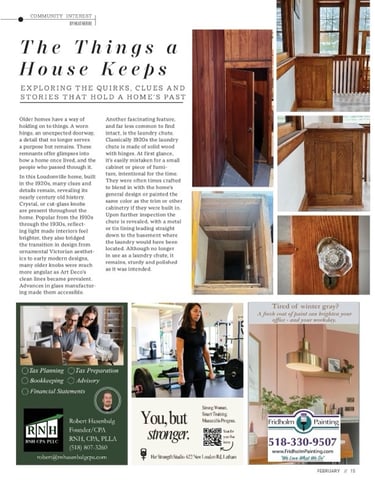
The Things A House Keeps
Exploring the quirks, clues and stories that hold a home's past.
Older homes have a way of holding on to things.
Not only the items that may have collected in the attic or the basement, but a worn hinge, an unexpected doorway, a detail that no longer serves a purpose but remains. These remnants offer glimpses into how a home once lived, and the people who passed through it.
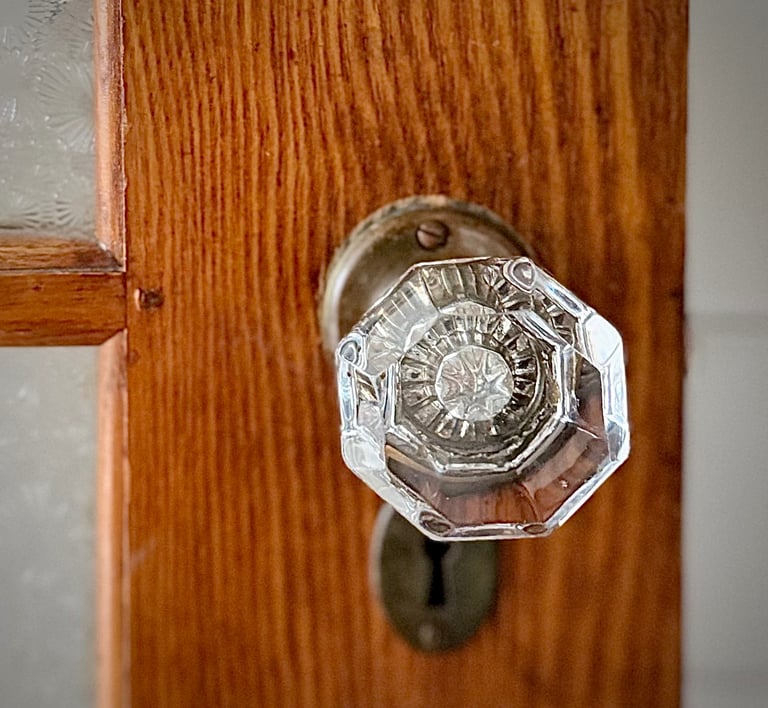
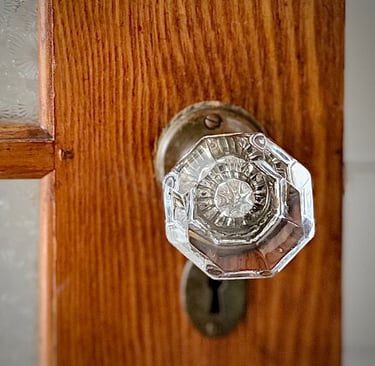
In this home, built in the 1920s, many clues and details remain, revealing its nearly century old history. Crystal, or cut-glass knobs are present throughout the home. Popular from the 1910s through the 1930s, reflecting light made interiors feel brighter, they also bridged the transition in design from ornamental Victorian aesthetics to early modern designs, many older knobs were much more angular as Art Deco's clean lines became prevalent. Advances in glass manufacturing made them accessible.
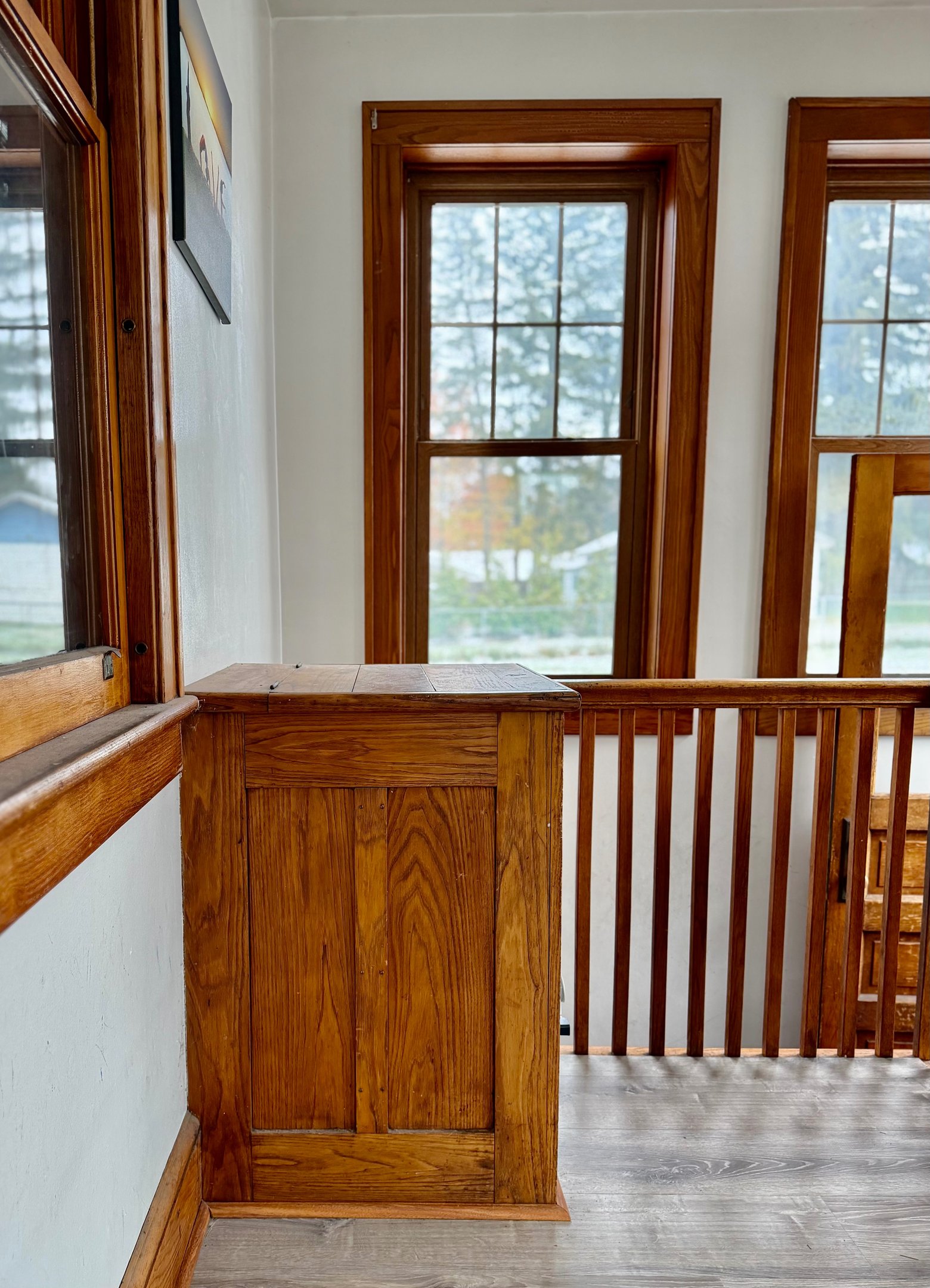
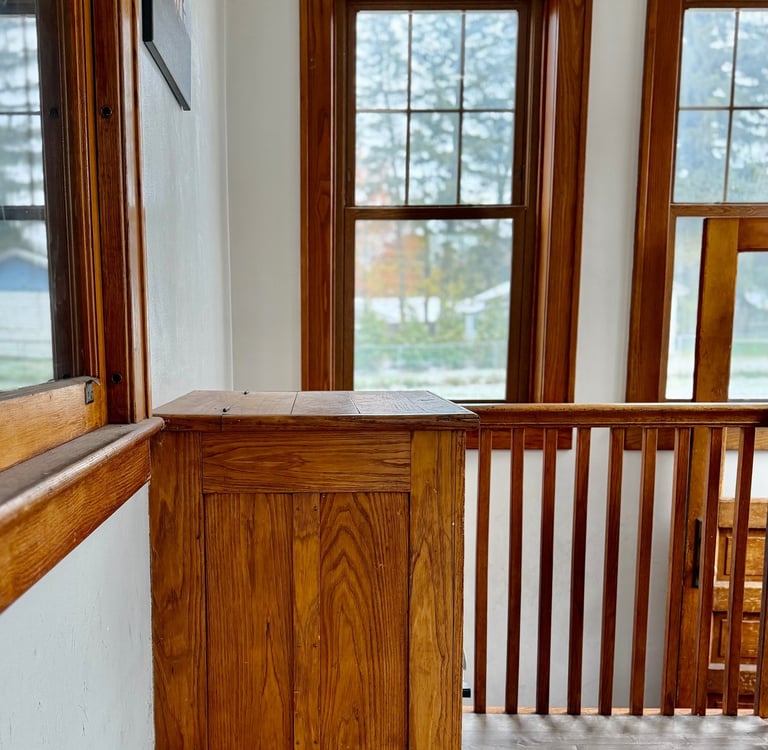
Another fascinating feature, and far less common to find intact, is the laundry chute. Classically 1920s the laundry chute is made of solid wood with hinges. At first glance, it's easily mistaken for a small cabinet or piece of furniture, intentional for the time. They were often times crafted to blend in with the home's general design or painted the same color as the trim or other cabinetry if they were built in. Upon further inspection the chute is revealed, with a metal or tin lining leading straight down to the basement where the laundry would have been located.
No longer in use as a laundry chute, it remains, sturdy and polished. The lid may not be opening throughout the day, ushering laundry to the basement, but it serves a purpose. It is a silent but continuous reminder of the craftsmanship, attention to detail and custom fittings that are all parts of what makes the home unique. An integral part of the things a house keeps.
Written by Heather Ré
Puclished, May 2026
Photography by Heather Ré
Publication Layout & Design
Editorial Design • Content Organization • Visual Hierarchy • Typography Selection • Publication Production • Publication Cover Design • Photography Direction
Layouts designed to support readability, visual flow, and audience engagement through thoughtful typography, photography, and content organization.